
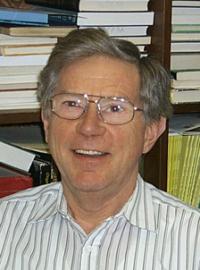
Iain E.P. Taylor was born along the Welsh border in the town of Chester in England on August 18, 1938. Taylor’s interest in the sciences began in high school and, in 1957, he attended the University of Liverpool. In 1960, he obtained a Bachelor of Science in Botany and Zoology. The following year, he obtained another Bachelor of Science in Botany (Honours) with a specialization in Plant Physiology and Biochemistry. In 1964, he completed a Ph.D. for the Department of Botany studying the structure of jack-bean urease (a metalloenzyme, which catalyzes the hydrolysis of urea to produce ammonia and carbon dioxide).
After his Ph.D, Taylor realized he wanted a more hands-on instructional role and accepted a job at Blundell’s School in Tiverton, England, to teach high school biology. In 1967, Taylor accepted a post-doctoral position for the University of Texas in Austin. Before leaving, he married Sylvia Taylor.
Taylor stayed in Austin for one year before relocating one final time to the Department of Botany at the University of British Columbia. He worked as an Assistant Professor starting in 1968, where his focus was to redesign the introductory biology courses. In 1971, Taylor became an Associate Professor and was granted tenure in 1973. Two years later, Taylor began a one-year study leave at the Department of Biochemistry at LaTrobe University in Melbourne, Australia. Upon returning in 1976, Taylor was the Director of First Year Biology until 1979. In 1983, Taylor took another study leave to work with the UBC Department of Botany and Physics before returning to be a Professor of Botany.
In 1991, Taylor was appointed the Acting Head of the Department of Botany as well as the Associate Director of the Biology Program. Three years later, Taylor became the Head of the Department of Botany, a position he held until 1999. Hereafter, Taylor began a reduction of duties in anticipation of his eventual retirement in 2004. This included acting as a Visiting Scientist at the UBC Botanical Garden and a joint appointment between the Faculty of Sciences and the Faculty of Agricultural Science. At the Botanical Garden, Taylor also worked as the Acting Director and Research Director. In 2002, Taylor revived the Botanical Garden’s scientific publication, Davidsonia, which he oversaw as the Editor.
Around this time, Taylor also worked to consolidate records and information about the history of the Department of Botany, which included organizing the department’s catalogue and making their resources more accessible. This sparked an initial interest in the history of science at UBC, which would eventually become Taylor’s decades-long work on the UBC Centenary Project.
Throughout his career at UBC, Taylor was passionate about teaching and editing for scientific journals. Taylor frequently taught undergraduate courses and supervised fourteen Ph.D students, two Master of Science students, and five undergraduate theses. Starting in 1968 and throughout the 1970s, Taylor’s research interested focused on understanding fungal and plant cell wall compositions and how they changed with growth. His emphasis on qualitative analysis to ensure greater sample recovery later became the gold standard for cell wall composition analysis. In 1978, Taylor worked with Dr. A. MacKay from the Department of Radiology and Physics at UBC on solid state proton nuclear magnetic resonance to better understand the structure and architecture of the plant cell wall. This research would continue until 1993, alongside work to culture trees from explants of mature conifers, such as lodgepole and ponderosa pines.
From 1993 onwards, Taylor shifted his research and studies to focus on professionalism in science, codes of ethics for science research, science journalism, authorship, intellectual property, and the peer-review process. Taylor also worked to demystify the writing and publishing of academic materials in the sciences and hosted workshops on the topic aimed at post-graduate students. His research on scientific ethics and publishing has continued throughout Taylor’s retirement, where he has also taken an interest in choir and theatre.